
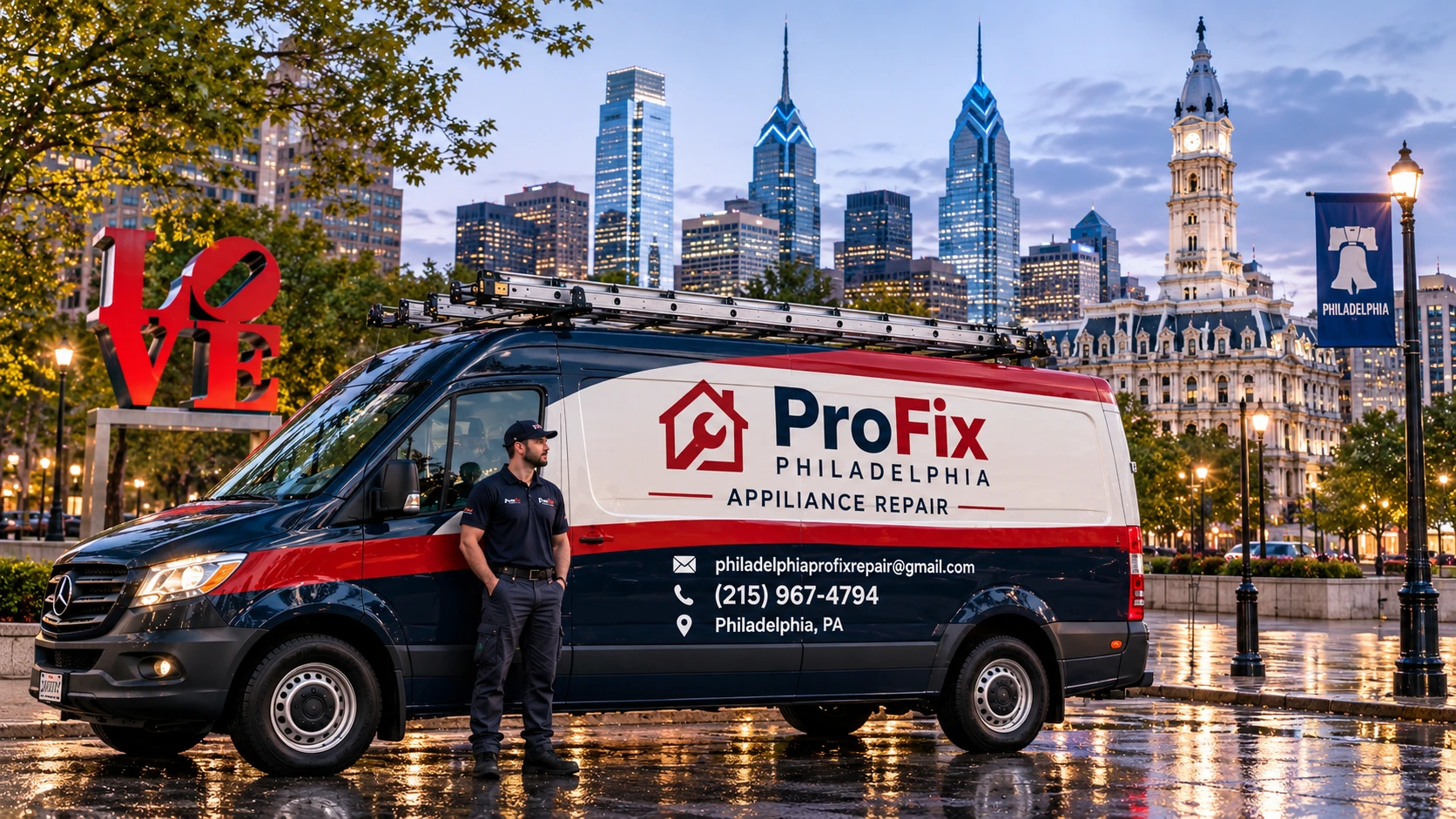
Philadelphia loses power in every season. Summer thunderstorms bring down trees and lines in a single afternoon. Nor'easters and ice storms pile weight on branches through the winter. And every so often the remnants of a tropical storm arrive, as Ida did in September 2021, with flooding in low areas like Manayunk and Eastwick on top of the outages. Most outages are short. Some last days. The steps below work for both.
Before the storm
When a strong storm is in the forecast, a few minutes of prep makes the outage much easier on your food and your appliances.
| Do this | Why |
|---|---|
| Put an appliance thermometer in the fridge and the freezer | After the power returns, the thermometer, not the smell, tells you what's safe |
| Turn the fridge and freezer a little colder | Starting colder buys you extra time |
| Fill empty freezer space with containers of water | A full freezer holds its temperature far longer than a half-empty one |
| Freeze a cup of water and put a coin on top once it's solid | If the coin is at the bottom later, the freezer thawed and refroze while you were away |
| Move the sump pump and appliance plugs off the floor if the basement floods | Basements in older parts of the city can take water in heavy rain |
| Plug sensitive appliances into surge protectors | Control boards are vulnerable to spikes when power comes back |
| Know how you'll report an outage to PECO | Have the app or the PECO website bookmarked on a charged phone |
During the outage
Keep the doors closed
This is the single most important rule. According to the FDA's guidance on food and water safety during power outages, a refrigerator keeps food cold for about 4 hours if it stays unopened. A full freezer holds its temperature for about 48 hours, and a half-full one for about 24 hours, with the door closed. Each time someone opens the door to check, that clock speeds up.
Unplug what you can
Turn off or unplug the range (electric models), microwave, dishwasher, washer, dryer and anything with an electronic control board. Leave one lamp switched on so you know when the power is back. When the power returns, it can come back with a surge, and sometimes it flickers on and off several times while crews work. Each flicker is a jolt to compressor relays and control boards.
Report it
Report the outage to PECO through its website or app rather than assuming a neighbor already did. If you see a downed line, stay far away and report it right away. Treat every downed wire as live.
Generator safety in a rowhouse city
Portable generators help during long outages, but carbon monoxide from them kills people every year, and rowhouse living makes the risk harder to manage. Exhaust from your generator can drift into your own windows or your neighbor's.
- Never run a generator indoors. That includes the basement, an attached garage, an enclosed back porch and a covered breezeway, even with doors and windows open.
- Keep it well away from openings. Ready.gov's power outage guidance and the CDC both say to keep a generator outdoors at least 20 feet from windows, doors and vents. In a small rowhouse yard, that may not be possible; if it isn't, don't run it there.
- Have working CO alarms on every level, with battery backup. The CDC's carbon monoxide basics page covers the symptoms.
- Never backfeed. Plugging a generator into a wall outlet or dryer receptacle can send power back into the lines and endanger utility crews and neighbors. If you want to power household circuits, an electrician needs to install a proper transfer switch.
- Use heavy-duty outdoor extension cords sized for the load, and run the refrigerator directly from the generator rather than through a chain of cords.
- Let it cool before refueling, and store fuel outside the living space.
After the power comes back
- Wait a few minutes before plugging appliances back in, so the grid can stabilize.
- Read the thermometers. The FDA advises throwing out refrigerated perishables like meat, poultry, seafood, milk, eggs and leftovers that have been above 40°F for 4 hours or more. Don't taste-test to decide.
- Check the freezer. Food with ice crystals, or a thermometer reading of 40°F or below, can be refrozen according to the FDA, though quality may suffer.
- Toss the ice. Empty the ice bin and discard the first batch of new ice.
- Run each appliance once. Start a short dishwasher and washer cycle, preheat the oven, and confirm everything finishes.
- Watch the fridge for a day. It should be back to 40°F or below within several hours. If it isn't, something may have been damaged.
If the basement flooded too
Storms that knock out power often bring basement water with them, especially along the Schuylkill in Manayunk and in low-lying neighborhoods. Don't plug in or switch on any appliance that sat in water, including a washer, dryer, chest freezer or water heater. Water can damage motors, controls and gas valves in ways you can't see. The basement flooding appliance checklist covers what to do next.
Signs the outage left damage behind
- Fridge or freezer runs but won't cool, or the compressor clicks without starting.
- Blank, flickering or scrambled displays.
- Error codes that weren't there before the storm.
- A breaker that trips each time an appliance is plugged in.
- A burning or hot-plastic smell. Unplug the unit and leave it off.
A chest freezer in a basement deserves its own look after an outage; see the chest freezer not freezing checklist.
When to call a technician
If an appliance hasn't recovered by the next day, or shows any of the warning signs above, call us. A surged control board is a common outcome, but it isn't always the failed part, so our refrigerator repair and freezer repair technicians test the supply and components first, then give you a written estimate before any work. After a big storm, schedules fill quickly; same-day service is possible when the schedule allows. Use the booking form or call us.